
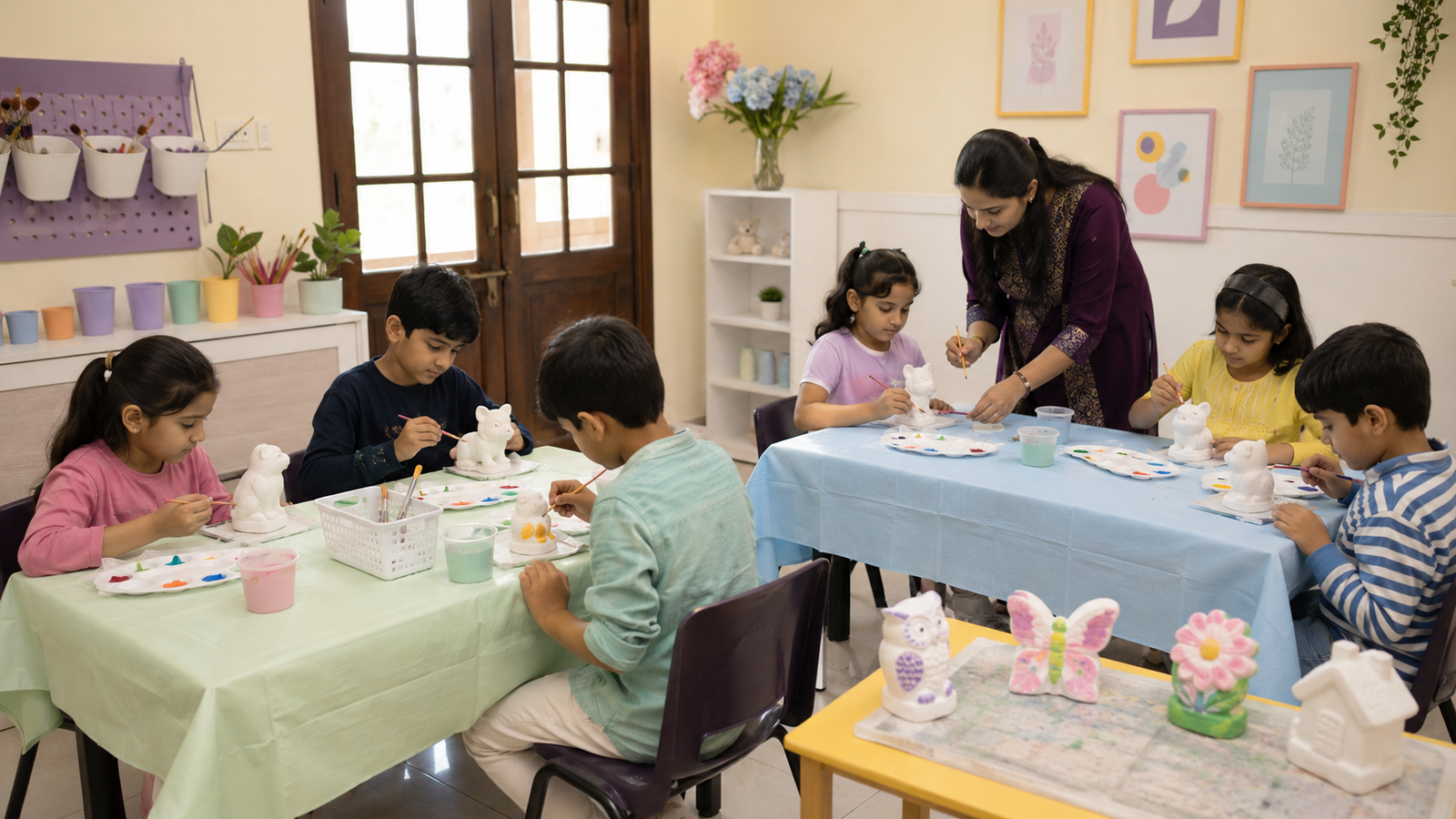
A successful kids’ painting workshop does not need a complicated stage or dozens of shared supplies. It needs a clear activity, age-appropriate materials, an organized table and enough time for every child to finish without feeling rushed.
If you are planning a kids’ painting workshop in Islamabad or Rawalpindi, this guide will help you choose a theme, calculate materials, arrange the room and run the session smoothly for 10, 20, 30, 50 or more children.
Why plaster painting works well for group activities
Each child starts with an unpainted white plaster figure and turns it into something personal using colours and a brush. The instructions are easy to understand, but no two finished pieces look exactly the same.
It also gives every participant a creation to take home. That makes plaster painting suitable for schools, daycares, summer and winter camps, birthday events, community sessions and family days.
Step 1: Confirm the children’s age range
The age range affects the figure size, level of detail, instructions and session pace. Younger children generally benefit from larger shapes, fewer colours and short demonstrations. Older children can handle more detailed figures, colour mixing and patterns.
For a mixed-age group, choose simple figures that younger children can manage while leaving enough open space for older children to add detail.
Step 2: Count participants—and add a small buffer
Confirm the expected number of children before ordering. For events with uncertain attendance, keep a few extra kits available so late additions do not have to share. Individual packs make distribution faster and help organizers see immediately if every child has received materials.
Nooru’s Happy Palette offers customized bulk kits for groups of 10, 20, 30, 50 or more children. Share your group size and event requirements to discuss a suitable pack.
Step 3: Select one clear theme
A strong theme makes the workshop easier to introduce and more memorable. Popular options include:
- Space: rockets, planets, astronauts, stars and spaceships.
- Vehicles: cars, buses, aeroplanes and boats.
- Animals: familiar characters that can lead into stories and sound games.
- Sea world: useful for ocean, nature and summer-event themes.
- Fruits, donuts and candies: playful options for colourful sessions.
- Insects and honey bees: suitable for nature-inspired activities.
When the workshop is linked to a school topic or birthday theme, match the figures to it. For a general creative session, a mixed selection can give children more choice.
Step 4: Choose the right kit format
For a kids’ workshop, the easiest setup is usually one pack per participant. Each pack should clearly contain the figure or figures, paints and brush needed for that child. Shared palettes and water cups can be placed at intervals along the table.
A simple pack works well for high-volume distribution. A gift-box option may suit a premium event or a workshop where the unopened kit is presented as a take-home gift.
Step 5: Plan the room layout
Arrange seats so the facilitator can walk between tables. Protect surfaces with mats, paper or reusable covers, and place drying space away from active elbows.
- Seat children in small table groups rather than one crowded line.
- Keep water cups stable and do not overfill them.
- Place wipes or cloths at each table.
- Keep extra brushes and paints at the facilitator’s station.
- Create one clearly marked area for completed figures.
Step 6: Prepare a simple workshop timeline
The exact timing depends on age, group size and figure detail, but this structure is a useful starting point:
- Welcome and distribution: introduce the theme and give every child a kit.
- Short demonstration: show how to use a small amount of paint and where finished pieces will go.
- Creative painting time: allow children to choose their own colours and work at their pace.
- Finishing details: help children add patterns, names or final touches if appropriate.
- Gallery moment: place the creations together and celebrate the variety.
- Pack-up: return dry or protected pieces to their owners and clear the tables.
Keep the demonstration brief. Children understand the activity fastest when they can begin painting rather than listening to a long explanation.
Step 7: Make instructions easy to follow
Use three simple rules: paint your own way, keep materials on the table and ask before taking extra supplies. Avoid showing one “perfect” finished example as the only correct result. The workshop should encourage imagination, not copying.
Step 8: Plan how creations will travel home
Wet paint and crowded bags do not mix. Prepare labelled trays, paper bags or protective packaging, and tell parents or teachers if a figure still needs drying time. For school workshops, group finished pieces by class or section.
Workshop planning checklist
- Event date and location
- Expected number of children
- Age group
- Selected theme
- Kit type and packaging
- Tables, chairs and surface protection
- Water cups, wipes and drying area
- Extra materials
- Take-home and labelling plan
Ordering kids’ workshop kits in Islamabad
Nooru’s Happy Palette prepares screen-free DIY painting kits for children aged 3–12. Bulk packs can be customized for school activities, birthday events, camps and kids’ workshops according to group size, theme and packaging needs.
Plan your kids’ painting workshop in Islamabad or browse the available painting-kit themes before requesting a bulk estimate.
Frequently asked questions
How many kits should I order for a workshop?
Order one kit per child and consider a small number of extras when attendance may change.
Can workshop kits be customized by theme?
Yes. Theme combinations and pack contents can be discussed according to the event and available options.
Are painting kits suitable for school activities?
Yes. Individual kits simplify distribution and the finished figures give children a project to take home.
What details are needed for a bulk estimate?
Share the date, city or venue area, number of children, age range, preferred theme and packaging requirement.